Writing this from the perspective of an American, I will gloss over the fact that in Japan they drive on the left side of the road. Sure it’s unique to fellow Americans, but other English speaking countries also drive on the left so it’s not that big of a deal as there are certain aspects to driving in Japan you would not expect from a developed country (aside from driving on the wrong side of the road!) that are noteworthy.
Navigating the roads in Japan by means conventional to westerners – e.g., Google Maps – can be quite a challenge. Driving down the freeway in Japan is one thing, sure the speed limit is rather low, but it is wide and there are generally quite a few lanes. Driving on main roads in the city is also fairly straight forward, however a lot of places you might want to visit are not on the main streets. The side streets in cities and most roads in small towns pose the real challenge and can lead to quite the adventure.
No wonder Japan is one of the hardest countries for locals to get a driver’s license. Most Japanese take driving lessons (that can cost around $2000!) before they attempt the test to get their license. Luckily foreigners have an easier time converting one from their home country, or if in Japan for less than a year, an IDP will do just fine, or sometimes just exploring on foot is the way to go.
Is this a one-way?

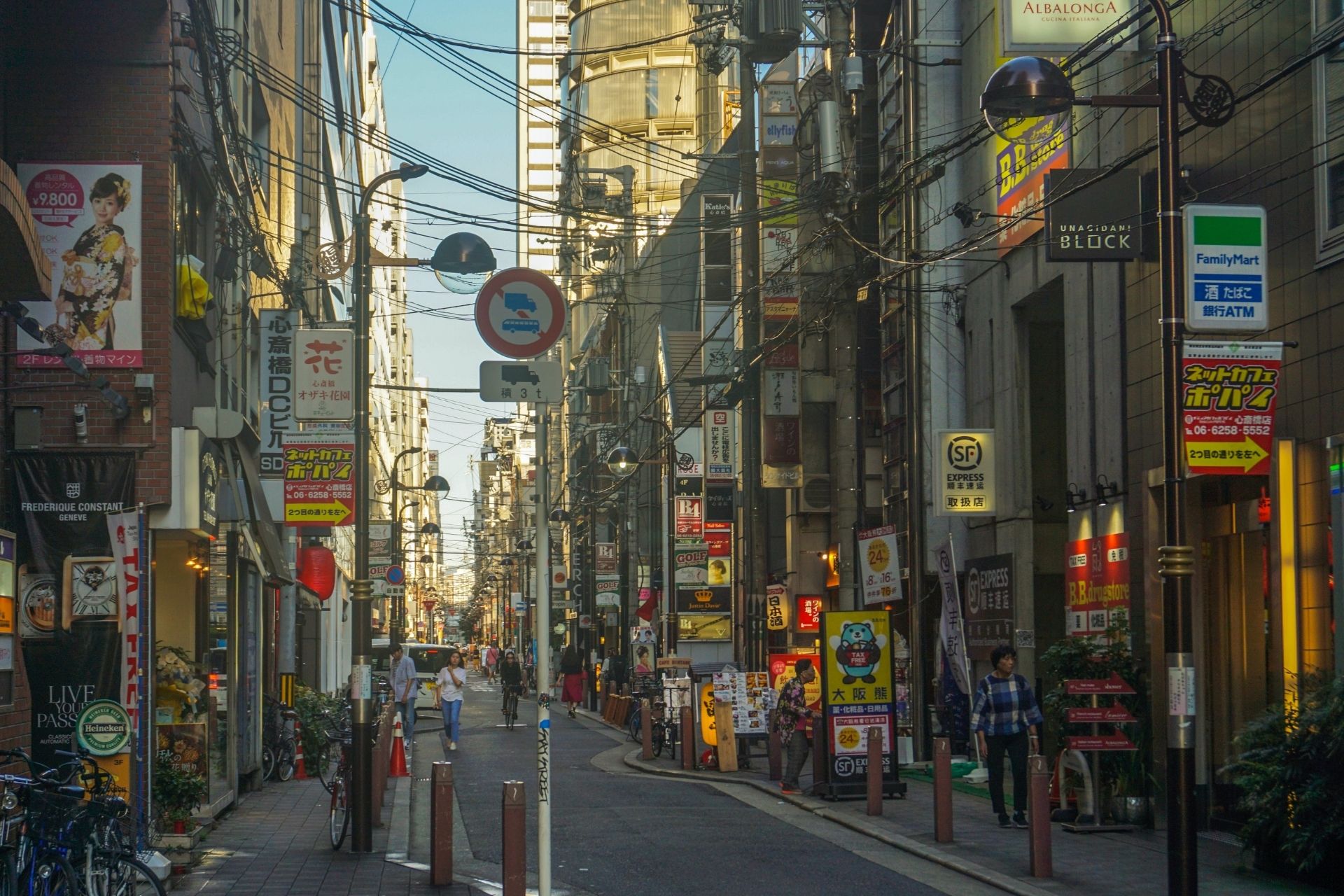
Even knowing where you’re going in general doesn’t change the fact that many roads are narrower than comfortable. I’ve driven down many roads where I can only think to myself “This has to be a one-way road” due it barely being wide enough for my small kei-car. Just as I’m thinking that, I see an oncoming car and realize that it is in fact a two-way road, it just isn’t wide enough for two cars at once.
That gives you two options depending on the situation. The first is to drive onto the ‘sidewalk’ or shoulder to give enough room, but that’s only if there is one. The other option is to hope you are by a conveniently placed pullout spot, just wide enough for you to wait while the oncoming car passes. Kei cars are all the rage here, and for good reason, if I had a car as wide as a normal American vehicle, I am not sure I would (or even could) drive down half of the streets I find myself on during my daily commute.

Where does it want me to turn?
Beyond the width of the road, intersections in general can make you question if you actually know how to drive. There are three major issues I have that make me often make the wrong turn.
With many small roads right next to each other, the default view in Google Maps doesn’t help much in figuring out which one to turn onto. If you’re also not used to being navigated in meters (how far away is 50 meters?), then being told the distance doesn’t help much. The worst part of it? Most roads don’t have names! Major routes and roads leading to major points of interest are labeled as such, but most normal roads are not. “Turn left in 50 meters” doesn’t tell you much when there’s a 3 lefts within short distance of each other.
Google Maps is notoriously bad for navigating down small roads that might save a minute compared to main roads, but make you question your sanity at the same time, especially if you’re trying to locate a coffee shop in the middle of a residential neighborhood (that also happens to be a house that blends in with all the other houses).
But I Don’t Have a Toll Card…
The freeway system in Japan has free highways that have lower speed limits and sometimes only one lane for each direction. These highways also pass through cities and end up having stoplights when you arrive to a town. Along the coast in Shizuoka, we have “The 1” – just like both coasts in the US. There is also the express road, where you have to pay a toll. “The E1” and “The E1A” both run rather parallel to The 1 through Shizuoka. Most interchanges have a both to pick up a ticket or had over your ticket and the toll fee. Some exits ONLY have ETC entrances and exits.
What is ETC? It’s Japan’s toll card. Perks of having it mean not having to stop when entering or exiting the toll roads. The issue with Google Maps is that it doesn’t know which exits are ETC only. Some rental cars will come with an ETC, but many will not. As someone with a lease car, it is a process to get an ETC card without a Japanese credit card.
So what do you do when Google leads you to an ETC entrance or exit? You have to turn around and find a different exit, or go PAST where you wanted to get off to find a non-ETC exit. That added about 30 minutes and 10 kilometers to what should have been a 20 minute drive for me once. Ouch.
Is this even a road?
Another quirk of Google Maps is when it can’t differentiate a road and a pedestrian path. On three separate occasions, I’ve had Google Maps tell me to drive down a path that was clearly marked as “Pedestrians Only”, or a path that had a pole down the middle of the path specifically to prevent cars from driving down it.
Do you have any experience driving in Japan or a comparable country? Italy is still the country with the most aggressive drivers that I’ve ever had the experience of driving in. Share your experiences in the comments!